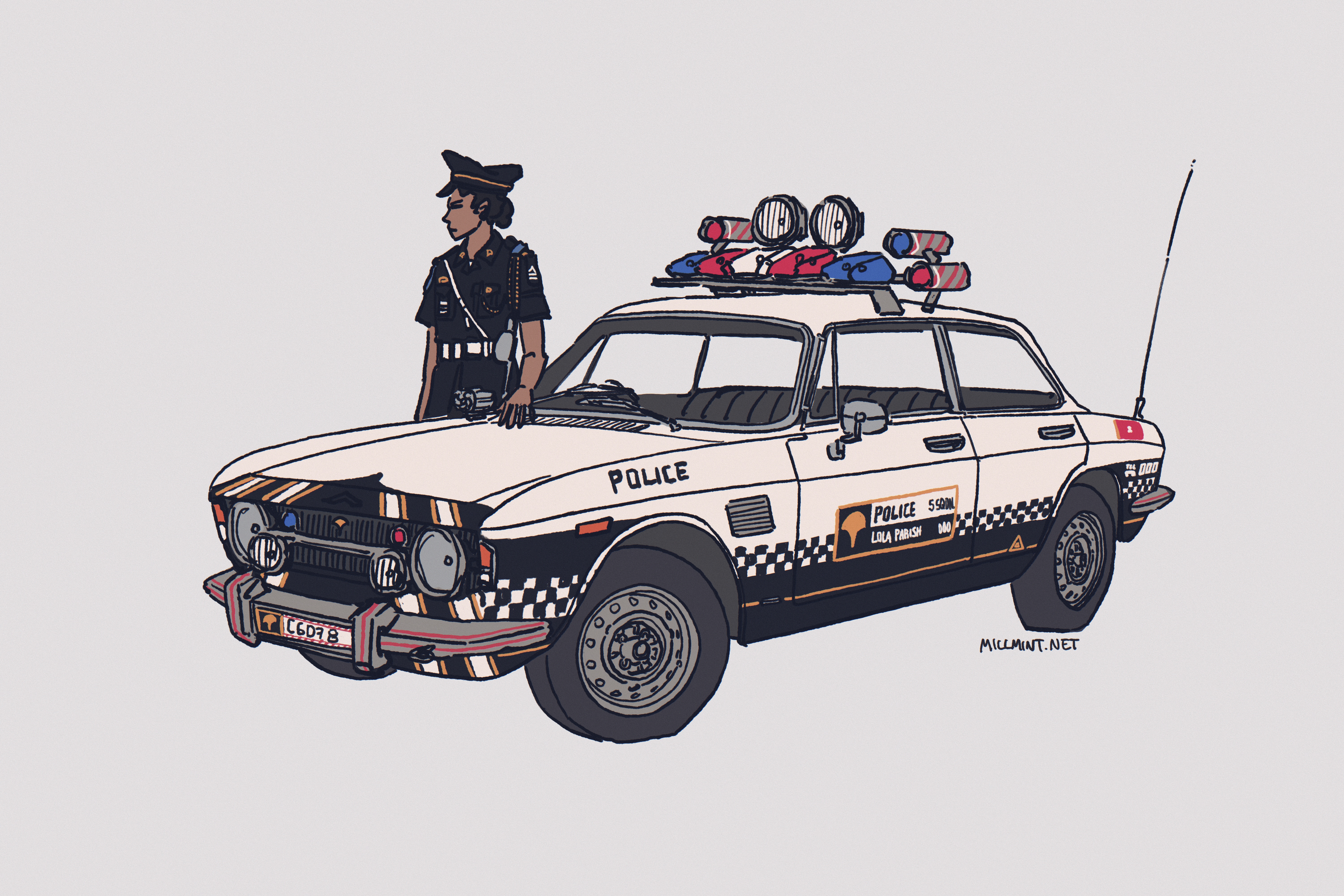
The Police is a constituent organisation of the Mandatory Services.
| Police | |
|---|---|
| Mandatory service of the Commonwealth | |
| Act | Commonwealth Police Act (2054) |
| Authority | Parliament of Law |
| Circuits | 10 |
| Departments | 7 |
| Head | Commissioner of Police |
| Headquarters | Oslola |
| Officers | ~80,000-90,000 |
| Ranks | Commonwealth rank structure |
| Sidearm | .45 APC Police Special |
| Training | Commonwealth Police College |
The Commonwealth Police Service or Constabulary is the unified, uniformed police service of the Commonwealth, and a mandatory service whose cadre authority is the Parliament of Law. Its authority and jurisdiction are defined by the Commonwealth Police Act of 2054. All constables are commissioned under Commonwealth authority, and policemen1 take on many roles and uniforms throughout their service.
Police in the Commonwealth are an armed force under national commission, like soldiers. In this sense, policing is an expression of the authority to use force, and is not separated from or subordinated to military service. It is instead distinguished by the structure and charter of its officers, who are civilian in character but able to act as a military auxiliary as required. Depending on their post and rank, police officers may train and lead military units in time of war. Vice versa, soldiers may attain a police commission and enforce laws.
The Service has no rigid departmental forces. The police commission is treated as a flexible system in which officers hold several specialist endorsements at once, which reduces jurisdictional overlap between police functions and distributes the expertise of officers. The structure suits the scattered island geography of the Commonwealth, and helps uphold consistent professional standards in its most distant republics.
Commissions and Endorsements #
Every officer completes fundamental training at the Commonwealth Police College, which awards a base commission conferring the right to enforce Commonwealth and jurisdictional law and to make arrests. Constables then earn specialist endorsements through further training, and do not transfer between departments as police do overseas. The same officer might conduct different types of work on different days, moving between parish (local), detective and maritime roles in a single week. This breaks up the work and suits the eclectic, remote nature of much of Commonwealth policing.
Municipal policing in the Commonwealth is much like that of Europe or the United States. Beyond the municipalities is an internal frontier far from the regional commands, and many police stations serve wide insular areas. Officers are expected to staff peripheral stations as part of their service, and the variety is counted as an advantage of the system.
Constables hold active status in their primary role and reserve status in their other endorsements. Reserve endorsements activate during seasonal changes, emergencies, specialist requirements and officer shortages.
The computerised Duty Roster System2 records each constable’s active role, reserve endorsements, specialist skills, languages and availability. Regional police circuits help distribute them.
Many islands in Vekllei are too small or remote to have a permanent police constable. Circuit riders travel between them on regular schedules, carrying portable equipment and long-range radios, and provide specialist services there.
Endorsements #
Territorial #
- Territorial
- Parish
- Municipal
- Republic
- Federal
- Parish police serve smaller settlements, and the work is often part-time. Parish officers may be deputised by a permanent officer.
- Municipal police serve incorporated areas and municipalities. They handle most conventional policing and are generally highly localised to specific posts or stations.
- Republic police, also called the Police of the Public, are officers with a commission that confers jurisdiction over a republic, and thus allows them to provide general policing within a republic’s boundaries.
- Federal police have a commission that allows them to enforce federal laws and pursue crime nationwide, which generally requires specialised training.
Parish and municipal commissions are taught at the Constable Training School in Caimanas, and the federal commission at the College in Comet.
Functional #
- Functional
- Detective
- Marine
- Aviation
- Tribal
- Commons
- Detective endorsements comprise a number of specialised investigative skills taught at the Commonwealth Inspector Training School in Benahoare.
- Marine policing is a primary endorsement of three months.
- Aviation policing involves the operation of police aircraft, including helicopters and helijets.
- Tribal policing is carried out by Commonwealth Rangers, and the Tribal Commission Programme is taught at the National Ranger School in Kala.
- Commons police train in the Economics Legal Programme, one of the popular secondary endorsements, and are attached to the Commons Branch of the Criminal Investigation Department.
Detachments #
- Detachments
- Ranger
- Polar
- Equatorial
- Coastal
- Frontier Patrol
- Metropolitan
- Ranger
- Commonwealth Rangers handle environmental protection, national parks, marine reserves, uninhabited territory patrol and tribal policing. Each Ranger endorsement is taught by a police detachment of a national school: Coastal at NS Antigua, Polar at NS Sedna and Equatorial at NS Antigua.
- Frontier Patrol officers train in the Frontier Programme at the National Patrol & Scouting School, and the Internal Frontier Circuit of Demon and Aismious handles the Arctic fringe and remote weather station patrol.
- Metropolitan officers police the cities, including ports and harbours.
Special #
- Special
- Treasury
- Marshal
- Custodial
- Carriage
- Auxiliary Naval Company
- Rifles
- Animal
- Public Order
- Treasury police handle financial crime investigation, customs enforcement and revenue protection. They make the arrests in cases referred by the Department of Inspection of the National Economic Register, which investigates stock fraud, hoarding and structuring.
- Commonwealth Marshals pursue fugitives, protect witnesses and investigate crime across republic boundaries.
- Custodial police staff the federal penitentiaries and supervise community corrections for the Commonwealth Corrections Service. The endorsement is taught at the Commonwealth Correctional Centre in Meteor.
- Carriage police cover the common carriers, which are CommRail trains, Commonwealth Lines ferries and Commonwealth Airways aircraft. The National Police Aviation School is at AS Oslola.
- The Auxiliary Naval Company has Rifles, Animal and Public Order sections.
- The Rifles Section provides armed response, special weapons and tactics
- The Animal Section canine, horse and tracker units.
- The Public Order Section handles affray, public disorder and rioting.
The Rifles and Public Order sections train at the National Naval Training Centre at Fortress Falklands, and the Animal Section at Fortress Lola.
Commission & Attestation #
A police commission and a military attestation are separate warrants with different obligations, and can be held simultaneously. Servicemen may hold police endorsements, and constables may hold an attestation. The Patrol Service is made up of servicemen who are soldiers and constables simultaneously, exercising customs, immigration and criminal law authority at ports, airports and naval stations. Military policing is done by servicemen who hold the police commission.
Both warrants are graded in the single rank structure, and police appointments hold equivalent titles within it, which reflect their auxiliary and paramilitary character as a service. A constable is equivalent to an officer rank, a senior constable a Senior Officer and a sergeant a Chief Officer. A station sergeant is a Warrant Officer, an inspector a Commander, an intendant a Senior Commander, a superintendent a Secretary and a chief superintendent a Senior Secretary. The Deputy Commissioner and the Inspector-General of Police hold the rank of Commissioner, and the Commissioner of Police holds the rank of High Commissioner, which is equal to that of an admiral. Constables are addressed as Con.
Police are trained as gendarmerie, and in wartime they mobilise as a military reserve. The Commonwealth General Auxiliary, the volunteer militia, is raised and organised by gendarmes of the police forces.
Cadres #
The Police Service is one of the four mandatory services of the Commonwealth, alongside the Commonwealth Administrative Service, the Commonwealth Armed Forces and the Commonwealth Judicial Service. It was constituted as a mandatory service in 1966 under the Constitutional Settlement commission and reconstituted by the Commonwealth Police Act of 2054, and it is common to the federal government and the republics alike. This is why a republic needs no police force of its own.
Constables are recruited and trained federally and allotted to a republic cadre, or a joint cadre shared by several small republics, and the republic commission is earned within it. Officers holding the federal commission are carried on a separate federal cadre. Policing in federalising and external territories is done by the Territories cadre, which the Police Service shares with the other mandatory services, and its constables serve in Annobon, Java and the International Arctic Territories alongside the administrators and magistrates posted there. Policing of the common carriers, done in many countries by a separate railway or transport police, falls to the Carriage endorsement and needs no cadre of its own.
Organisation #
Command
- Commissioner of Police
- Deputy Commissioner
- Assistant Commissioners of the seven departments
- Secretary to the Commissioner
- Solicitor to the Police
- Inspector-General of Police
- Deputy Inspectors-General of the ten circuits
- Commandant of the Commonwealth Police College
The Commissioner of Police commands the Service from Police Headquarters in Oslola, and answers to the Parliament of Law. The Commissioner has two deputies. The Deputy Commissioner administers headquarters and its departments, and the Inspector-General of Police commands the circuits and most of the constables in them. The organisation of the Service is fairly traditional, and most of its titles are those of the old Indian Police.
Circuits #
The Service is divided into ten circuits, which act as operational areas and commands. Each circuit has a headquarter where the circuit keeps Police Lines and a reserve of armed police. Circuits are further subdivided as districts, divisions, stations and finally posts. Many posts are kept by a single constable, often a parish officer.
Each circuit also has an intendant, who keeps its stores, its quarters and its part of the Duty Roster. The cities are not part of any circuit. They are policed by metropolitan divisions, which answer to the Deputy Commissioner.
| Circuit | Seat | Other republics |
|---|---|---|
| Southern Ocean | Santes | Sude |
| Far Atlantic | Ascension | Helena |
| Western Caribbean | Providence | Paria |
| Exuma | Guanima | Rum and Curateo |
| Inagua | Inagua | Yuma and Yabaque |
| Leeward | Saba | Aloi and Allia |
| Western Azorean | Flores | Velas and Pico |
| Internal Frontier | Demon | Aismious |
| Gulf of Guinea | Annobon | Principe |
| Sotavento | Brava | Maio |
Departments #
Assistant Commissioners lead departments and superintendents lead branches. Headquarters keeps seven departments, and the Commissioner’s Office besides.
Commissioner’s Office
- Secretariat
- Solicitor’s Branch
- Parliamentary Branch
- Foreign Branch
- Press Bureau
Establishment Department
- Recruitment and Postings Branch
- Stores and Quarters Branch
- Wireless Branch
- Motor Transport Branch
- Police Surgeon’s Branch
Civil Police Department
- Parish and Municipal Branch
- Republic Branch
- Metropolitan Branch
- Traffic Branch
- Carriage Police
- Circuit Riders
Criminal Investigation Department
- Detective Branch
- Treasury Branch
- Commons Branch
- Antiquities Branch
- Criminal Records Office
- Fingerprint Bureau
- Forensic Science Laboratory
- Police Gazette
Special Branch
- Criminal Intelligence Section
- Security Section
- Ports Section
- Frontier Section
- Watchers
Armed Police Department
- Auxiliary Naval Company
- General Auxiliary Branch
- Armourer’s Branch
Marine Department
- Marine Police
- Port Wardens
- Police Diving Branch
- Police Air Wing
Ranger Department
- Coastal Rangers
- Polar Rangers
- Equatorial Rangers
- Frontier Patrol
- Tribal Police
The Criminal Investigation Department publishes the Police Gazette every week, and every station keeps a copy. The Forensic Science Laboratory is at Antigua.
Boards #
Because the Police Democracy Commission is elected by constables, the standards of conduct in the Service are largely set by the rank and file. Charges against officers go before the Board of Discipline, and complaints from the public are generally a matter for the watch committee of each municipality. Few constables reach station sergeant before they have passed the examinations of the Promotion Board.
Training & Recruitment #
Every constable passes through the Commonwealth Police College in Comet, which is the depot of the Service. It has taken about 2,800 recruits a year since 2018, and many of them have already served a term of Corsosva in the Armed Forces. Recruits enter as probationers and pass out with the base commission. Because police are trained as gendarmerie, the specialist schools at Benahoare, Caimanas, Antigua and Kala are mostly police detachments of the national military training schools. Constables posted to a new republic generally attend a training annex (at the larger stations) for its law, language and procedure.
Equipment and Technology #
The actual manner and procedure of Commonwealth Policing is fairly traditional, and officers use a mixture of traditional tools and modern technology. They also retain traditional equipment that has mostly disappeared elsewhere, most famously the use of police sabres.
Vehicles #
The Commonwealth has a standard fleet of police vehicles for different purposes.
- The Avro Police Cruiser GT is the standard police cruiser across the country, and about 1,850 are in service.
- The Avro Municipal Police Interceptor, introduced in 2055, is used for pursuit and highway patrol, and Oslola’s police service has the largest fleet.
- The Avro Commando Police Armoured Car is used for special operations and emergency response, and Oslola’s police service operates 31 of them.
Police Droids #
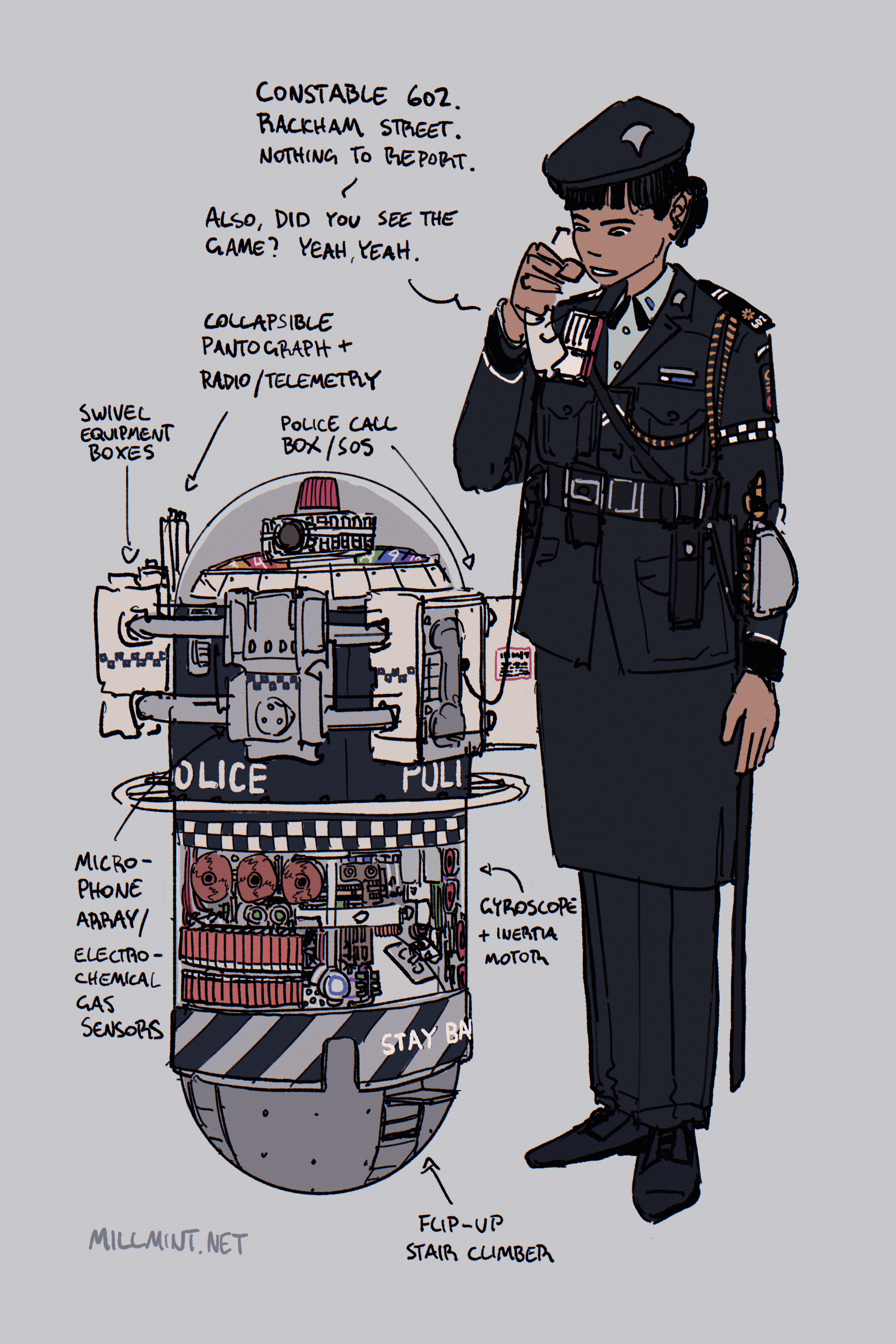
Droids and robots are used as police auxiliaries in many countries. The Commonwealth deploys autonomous police droids built by National Machines for routine patrol and support. The droids are barrel-shaped, and are controlled remotely from Automatic Asset Command centres, using optical computers to process sensor data and coordinate responses. They handle tedious tasks such as traffic control, area monitoring and equipment transport, and do not replace human officers.
Each droid has a modular equipment system, with tool boxes that lock onto a circular swivel rail around its midsection. Standard equipment includes first aid kits, communications equipment, crowd control speakers and dazzling lights, which are used for visibility and crowd dispersal. A droid can also carry a secure firearms container to deliver rifles to police if necessary.
Personal Equipment #
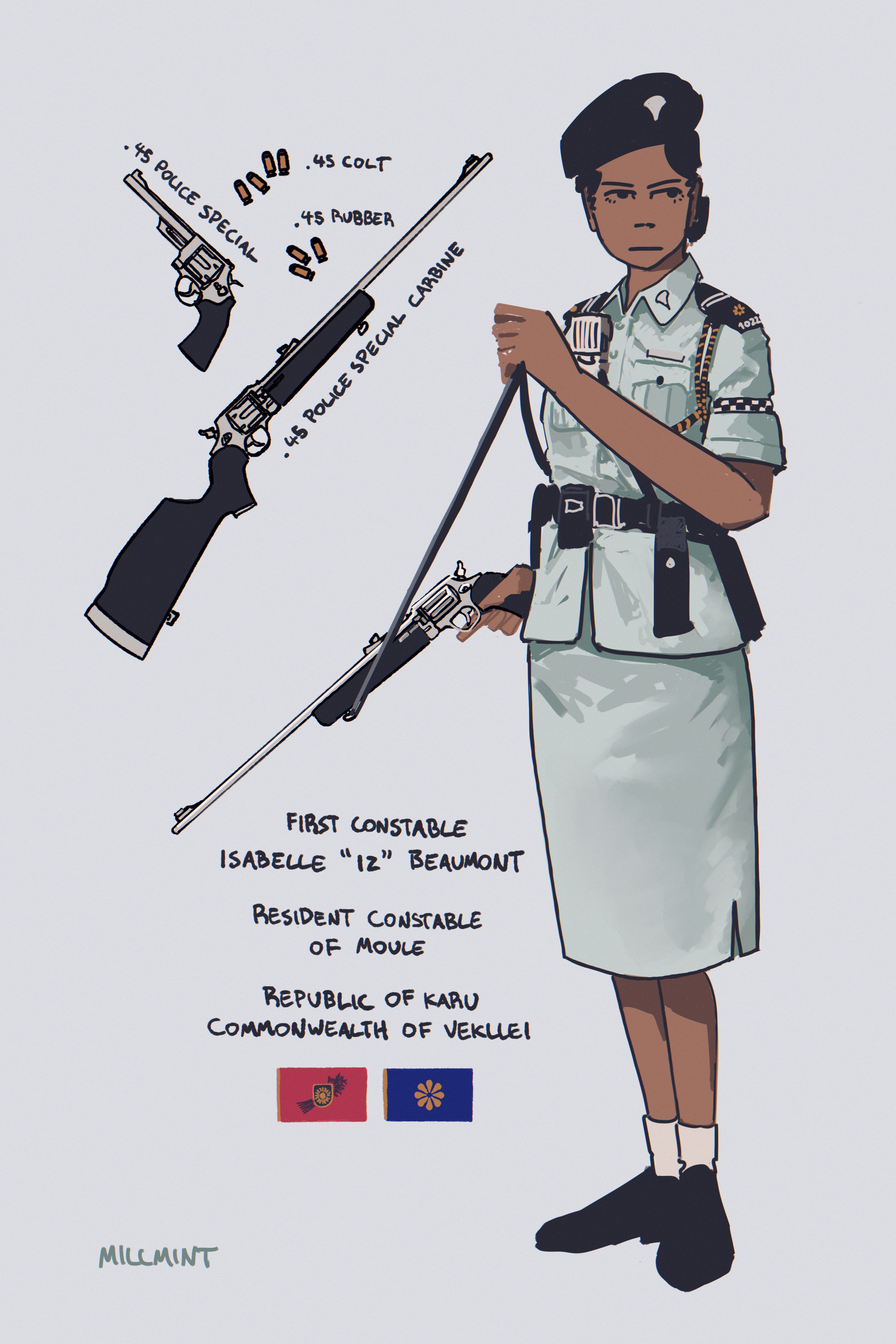
Commonwealth constables carry a combination of traditional and modern weapons. The standard sidearm is the .45 APC Police Special, a revolver designed for law enforcement use. Officers also carry a carbine version of the same weapon, with a stock, a lengthened barrel and a foregrip, for situations that need greater range or accuracy. Both weapons use interchangeable ammunition. Officers carry steel and rubber cartridges depending on the situation, along with speed loaders. The Commonwealth is awash with military rifles, but police do not typically carry them in ordinary duties. Specialised roles, like Commonwealth Marshals and the police Rifles companies, may carry military equipment.
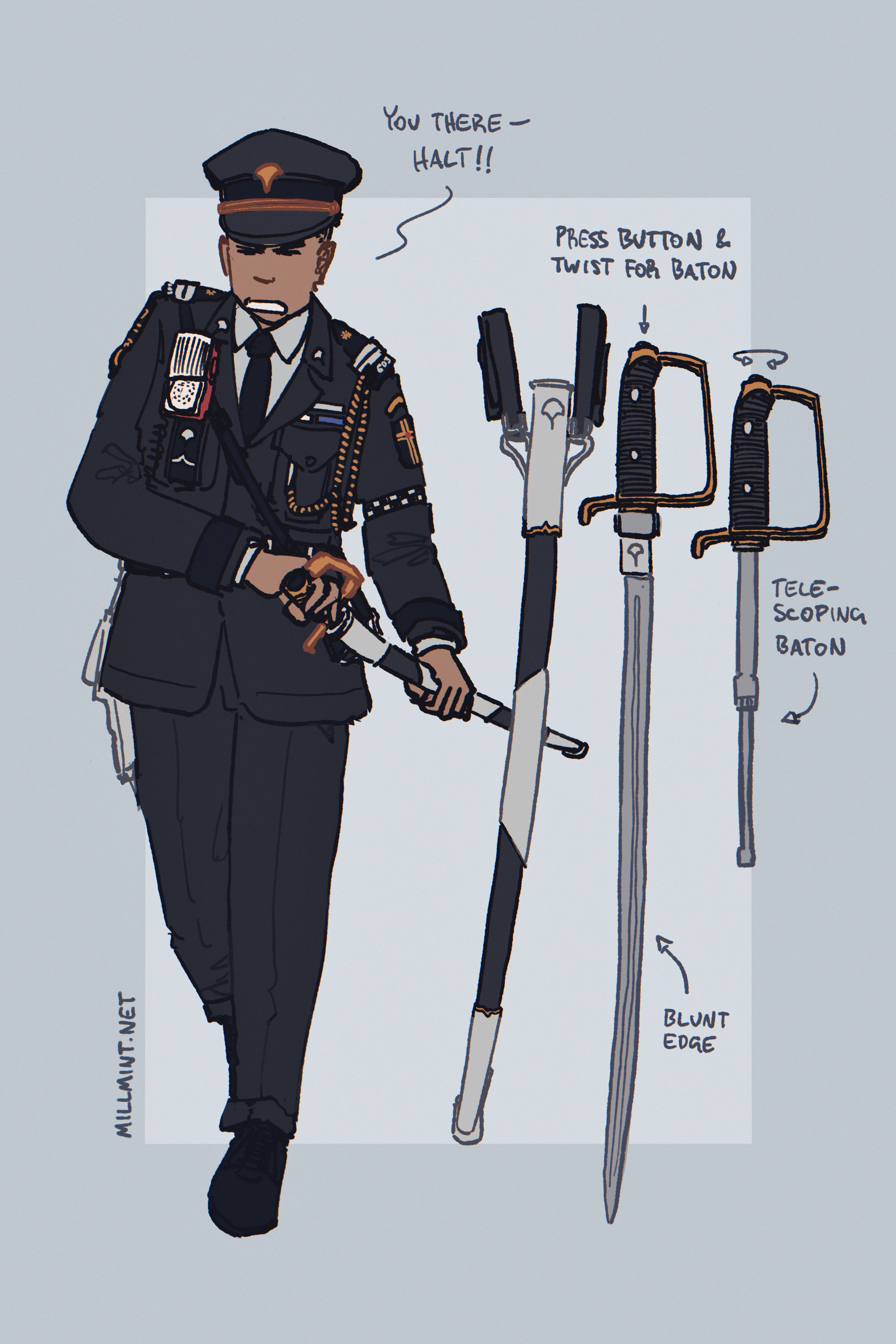
All constables are trained with sabres, which have a ceremonial use and several practical ones. The extra reach of a blade is often useful and sabre training builds physical conditioning and discipline. Officers may carry steel batons as well, or instead of the sabre in certain situations. They are symbols of authority in the country.
-
Vekllei does not typically gender titles, so women officers are also referred to as policeman. Specifying gender produces strange phrases like ‘woman policeman’ or ‘male policeman’. ↩︎
-
The Duty Roster System is primarily a computer programme. It shares data with other Commonwealth transport systems, so a sergeant can establish who can do what within a geographic area with two entries. ↩︎