Part of the country series of articles.
TRAVEL ADVISORY: EXERCISE CAUTIONPARSTATE advises that conditions vary significantly between Brasil's urban centres and its interior regions. Travellers should exercise caution outside major cities and avoid travel near the Amazonas border zone without consulting Commonwealth consular services.
| Federal Republic of Brasil | |
|---|---|
| Federal Republic | |
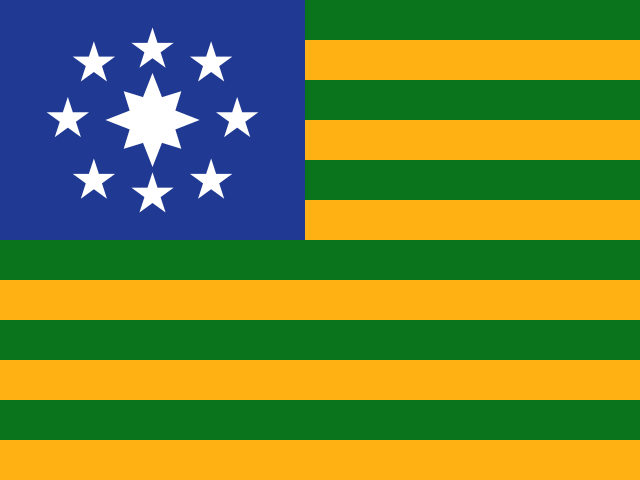 |
|
| Capital | Salvatoria |
| Languages | Spanish, Portuguese creoles, Italian, Japanese, Arabic, and many indigenous languages |
| Population | 98,400,000 |
The Federal Republic of Brasil is a large federal republic occupying most of the eastern South American landmass, the continent’s most populous and wealthiest country. It is Spanish in language and law – the consequence of the Iberian Union’s permanence, Portugal having failed to restore its independence in the seventeenth century and its colonial territories passing fully into the Spanish imperial system – with historical Moorish and Andalusian influences in its architecture and legal traditions, and an African cultural inheritance from centuries of slavery that shapes the country’s cities, music and religious life. Large waves of Southern European and Japanese immigration in the nineteenth and twentieth centuries added further populations, particularly in the southern states where Italian and Japanese communities remain distinct.
Political power is distributed among a rotating set of dynastic families and regional interests who have controlled Brasil’s federal institutions since independence, interrupted periodically by military governments. The great landowning families of the interior, the industrial interests of the southern states and the military have constituted the effective ruling coalition through most of Brasil’s history, regardless of which civilian government holds office. Salvatoria, the planned federal capital built on the site of the old colonial city, was intended to break the concentration of power in the coastal states and has had limited success in doing so.
Brasil’s northwestern frontier meets Amazonas, an impoverished indigenous republic that controls a substantial portion of the Amazon basin. The border is porous and subject to regular incursion by Brasilian logging operations and agricultural settlers. Brasil’s relationship with Amazonas varies between neglect, paternalism and opportunistic encroachment depending on which government is in office.