Part of the country series of articles.
TRAVEL ADVISORY: EXERCISE HEIGHTENED CAUTIONThe Commonwealth advises travellers to exercise heightened caution in this country due to ongoing instability, civil unrest or other risk factors. Travellers should avoid non-essential activities, keep a low profile and remain aware of local conditions at all times.
| Free Portuguese Republic of Mozambique | |
|---|---|
| Estado Novo Republic | |
 |
|
| Capital | Lourenço Marques |
| Languages | Portuguese (official); Emakhuwa, Changana, and many regional languages |
| Population | 36,000,000 |
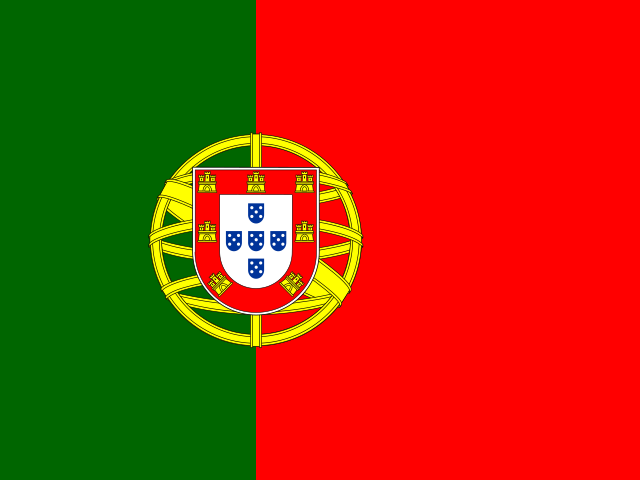
The Free Portuguese Republic of Mozambique is a white-ruled state on the southeastern coast of Africa, constituted by the remnants of Portugal’s Estado Novo regime following Spain’s annexation of Portugal in 1955. Estado Novo officials, military personnel and white settlers who refused incorporation into the Iberian Federation fled in the waning days of the regime to Mozambique – the largest and most economically developed of Portugal’s African territories – and occupied the existing colonial administrative infrastructure. The government claims continuity with the pre-annexation Portuguese republic and regards itself as the legitimate Portuguese state in exile. Its population of 36 million is predominantly Black African; the ruling settler and refugee community constitutes a small fraction governing through the inherited colonial apparatus.
The circumstances of Portugal’s fall were entangled in a decade of compounding grievances. The Estado Novo regime had backed the Francoist coalition during the Spanish Civil War, and its lusotropicalist foreign policy – premised on the idea that Portuguese colonialism was uniquely benign – put it at odds with the CNT-FAI coalition in Madrid as Spain became increasingly urgent about decolonisation.
Portuguese relations with its neighbour deteriorated quickly, leading to the expulsion of Spanish students in 1952 and accelerated by two separate massacres in Portuguese African territories which Madrid used to justify direct military aid to anti-colonial rebels. In 1955, war broke out over the assassination of Spanish president Javier Marx, and lasted less than two weeks. European Portugal was federated into a new Iberia, which drew strong condemnation from the UN and NATO to little effect.
Iberia does not recognise the government-in-exile in Mozambique. Relations with Lisbon, now a constituent territory of the Iberian Federation, are formally severed, and the exile government’s claim to represent Portugal has not roused much diplomatic support beyond its apartheid neighbours. Livre Portugal maintains close political and military alignment with Rhodesia to the west, the Union of South Africa to the southwest and Burmaland, with which it shares a common interest in resisting African nationalist movements and sustaining minority rule. It is with these states that the country conducts most of its trade.
Lourenco Marques is the capital and principal port, shaped by Portuguese urban planning with an art deco waterfront district that dates from the high colonial period. The port handles coal, aluminium and agricultural exports. Offshore natural gas reserves in the northern coastal zone have attracted investment from South African and European companies operating outside the international sanctions that several governments have imposed on the state. The interior economy is agricultural and extractive: cashews and tobacco in the central provinces, coal in Tete. Development is concentrated in the south; the northern provinces, where insurgent activity is most persistent, are substantially neglected.