
The Police is a constituent organisation of the Parliament of Law.
| Police | |
|---|---|
| Federal police force of Commonwealth of Vekllei | |
The Commonwealth Police Service or Constabulary is the unified, uniformed police service of the Commonwealth, and a constituent of the Parliament of Law. Rather than maintain rigid departmental forces, the CPS treats the police commission as a flexible system where officers hold multiple specialist endorsements at the same time, meaning they may hold multiple positions simultaneously.
All constables are commissioned under Commonwealth authority but serve different functions based on their active endorsements and where they’re needed. This means policemen1 take on many roles and uniforms throughout their service, which reduces jurisdictional overlap between police functions and helps balance the load of policing. The structure suits the Commonwealth’s scattered island geography and maintains professional standards across distant republics.
Philosophy and Structure #
Vekllei has a number of unique challenges in policing its vast and scattered island republics. It is a deeply federal country with many climates and cultures, and many police stations serve wide insular areas. The service comprises both regular municipal policing (much like you’d find in Europe or the United States) and an internal frontier, far away from regional commands. As such, police hold multiple roles in Vekllei through the endorsement system, which means they can perform different types of work as needed. It also has the advantage of keeping the work interesting for officers, who might be expected to staff peripheral stations as part of their service.
All officers with a police commission in Vekllei go through fundamental training at the Commonwealth Police College. Successfully completing this awards a base commission conferring the right to enforce laws and make arrests. From there, constables earn specialist endorsements rather than transferring between rigid departments as you might expect overseas. In this system, the same officer might serve as a parish constable on Monday, work detective cases on Wednesday, and patrol as a sea marshal over the weekend.
All officers hold a base commission as their foundation, which confers authority to enforce Commonwealth and jurisdictional law. They then specialise their role through endorsements, which require completion of specialised training programmes.
Endorsement Categories include:
- Territorial: Parish, Municipal, Republic, Federal jurisdictions
- Functional: Detective, Marine, Traffic, Tribal, Migrant, Commons (economic)
- Detachments: Ranger (Polar, Equatorial, Coastal), Frontier Patrol, Port Warden, Urban
- Special: Treasury, Parliamentary, Transport, Auxiliary Naval Company (Rifles, Animal, Riot)
Constables maintain active status in their primary role and hold reserve status in other endorsement specialisations. Reserve endorsements activate as required, usually during seasonal changes, emergencies, specialist requirements or officer shortages.
The computerised Duty Roster System2 shows each constable’s capabilities including their active role, available reserve endorsements, specialist skills, languages and availability. Regional Police Circuits manage deployment through a combination of routine seasonal shifts, priority specialist calls, emergency deployment and voluntary role changes.
Many islands in Vekllei are too small or remote to have a permanent police constable. In these cases, circuit riders travel between small islands on regular schedules, carrying portable equipment and long-range radios to provide specialist services to remote areas.
Organisational Structure #
Executive Command
Commissioner, Commonwealth Police Service
Deputy Commissioner for Operations
- Assistant Commissioner for Federal Services
- Assistant Commissioner for Republic Services
- Assistant Commissioner for Special Operations
Deputy Commissioner for Standards
- Assistant Commissioner for Training
- Assistant Commissioner for Professional Standards
- Assistant Commissioner for Police Democracy
Secretary for Legal Affairs
Secretary for Intelligence & Analysis
Secretary for Communications
Secretary for International Cooperation
Regional Police Circuits
- Southern Ocean Circuit: Santes and Sude; handles polar frontier and remote maritime coordination
- Far Atlantic Circuit: Ascension and Helena; coordinates mid-ocean transit and isolated community policing
- Western Caribbean Circuit: Providence and Paria; focus on reef protection and maritime borders
- Exuma Circuit: Guanima, Rum, and Curateo; regular patrols across the central Lucayan chain
- Inagua Circuit: Inagua, Yuma, and Yabaque; coordinates southern Lucayan port security and ferry escort
- Leeward Circuit: Saba, Aloi, and Allia; high-frequency shuttle policing for the northern Lesser Antilles
- Western Azorean Circuit: Flores, Velas, and Pico; manages deep-Atlantic volcanic and fishing zones
- Internal Frontier Circuit: Demon and Aismious; handles Arctic fringe and remote weather station patrol
- Gulf of Guinea Circuit: Annobon and Principe; equatorial operations and regional trade security
- Sotavento Circuit: Brava and Maio; archipelago transit and local parish services
Service Branches #
Federal Constables serve Commonwealth-wide functions:
- Commonwealth Constables: Also called Police of the Parliament or Federal Police, serving premier federal law enforcement roles
- Commonwealth Marshals: Fugitive pursuit, witness protection, cross-republic crime investigation
- Commonwealth Rangers: Environmental protection, national parks, marine reserves, uninhabited territory patrol, tribal policing
- Treasury Constables: Financial crime investigation, customs enforcement, revenue protection
- Parliamentary Guard: Government facility protection, Directory security, ceremonial duties
- Transport Police: CommRail security, ferry services, airports, space facility protection
- Commonwealth Police Companies: Specialised police sections for dedicated purposes
- Rifles Section — Armed response, special weapons and tactics
- Animal Section — Canine, horse and special tracker units
- Riot Section — Affray, public disorder, rioting
Republic Constables serve local community functions:
- Republic Constabulary: Also called Police of the Public, general policing within each republic’s boundaries
- Parish Constables: Community policing in smaller settlements, often part-time and elected locally
- Municipal Guards: City centre policing, event security, traffic management, tourist liaison
- Port Wardens: Harbour safety, maritime law within republic waters, fisheries coordination
Training and Professional Development #
Commonwealth Police College #
The Commonwealth Police College operates a network of training facilities providing all constables with standardised foundation training and specialisation tracks. Police training in Vekllei is structured like an old-school military service and maintain high standards. The curriculum emphasises Atlantic Municipalism and local competency across Vekllei’s diverse republics. New recruits are encouraged to pursue specialist endorsements to vary their work and develop their skills in law enforcement.
Training Structure:
- Foundation Course: 1 year Police Commission certification
- Primary Endorsement: 3-month specialist training for chosen focus area
- Secondary Endorsements: 2-week intensive courses for additional capabilities
- Continuing Development: Annual refresher requirements and new endorsement opportunities
Local facilities called Republic Training Annexes provide local skills training, cultural and language instruction, policing methods specific to each region, and republic-specific law and procedure.
Departments #
General Headquarters
- Office of the Commissioner
- Office of Parliamentary Liaison
- Office of Legal Affairs
- Office of Security & Intelligence
- Office of Public Communications
- Office of Personnel & Culture
- Office of International Relations
Operations Department
- Office of Federal Services Coordination
- Office of Republic Services Coordination
- Office of Special Operations Command
- Office of Emergency Response Coordination
- Office of Inter-Island Operations
- Office of Maritime Services
- Office of Transport Security
Standards Department
- Office of Training Standards
- Office of Professional Conduct
- Office of Police Democracy
- Office of Cultural Competency
- Office of Equipment & Technology
- Office of Health & Security
Specialist Services Department
- Office of Criminal Investigation
- Office of Financial Crime
- Office of Cultural Heritage Protection
- Office of Commons Enforcement
- Office of Environmental Crime
- Office of Forensic Services
Intelligence Department
- Office of Criminal Intelligence
- Office of Strategic Analysis
- Office of Surveillance Operations
- Office of Counter-Intelligence
- Office of Frontier Intelligence
Support Services Department
- Office of Communications & Technology
- Office of Vehicle & Equipment Management
- Office of Facilities Management
- Office of Medical Services
- Office of Legal Support
Regional Coordination Department
- Office of Circuits
- Office of Deployment
- Office of Supply
- Office of Inter-Republic Liaison
Commissions and Boards #
- Police Democracy Commission: Maintains professional standards, investigates misconduct, provides community accountability
- Training Accreditation Board: Oversees endorsement programmes, validates specialist training, manages ongoing education requirements
- Community Relations Board: Facilitates civilian oversight, manages community complaints, promotes police-community partnerships
- Equipment & Technology Board: Evaluates new technologies, standardises equipment across services, manages procurement
- Cultural Heritage Advisory Board: Guides heritage protection policies, liaises with indigenous communities, oversees cultural crime investigations
Equipment and Technology #
The Commonwealth Police employs a mixture of traditional tools and modern technology that reflects the character of their service.
Police Droids #
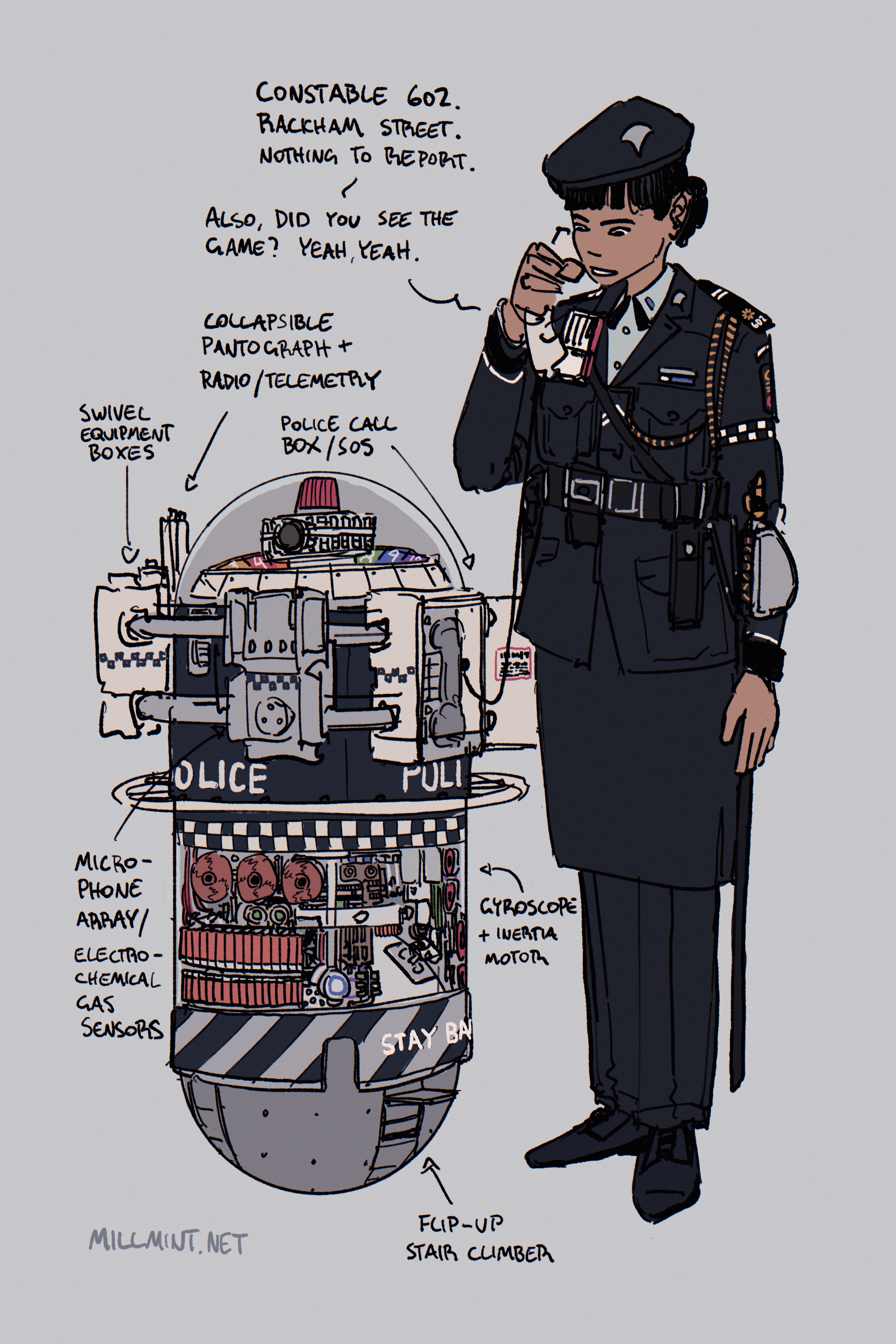
Many countries around the world now employ droids or robots as police auxiliaries. Commonwealth policing involves widespread deployment of autonomous police droids built by National Machines for routine patrol and support functions. These barrel-shaped robots operate under remote control from Automatic Asset Command centres, using sophisticated optical computers to process sensor data and coordinate responses. The droids handle tedious tasks like traffic control, area monitoring and equipment transport rather than replacing human officers.
The droids are deliberately non-threatening. They carry no weapons and instead rely on their substantial mass to physically interpose themselves between combatants, harmlessly but persistently ramming attackers until human officers arrive. Constables can summon droids via radio to block roads, provide emergency phone access or conduct environmental monitoring for hazards like carbon monoxide leaks.
They have a modular equipment system, with different tool boxes that lock onto a circular swivel rail around the droid’s midsection. Standard modules include first aid kits, emergency communications equipment, crowd control speakers and dazzling lights for visibility and crowd dispersal. They can also carry secure firearms containers to deliver rifles to police if necessary.
Personal Equipment #
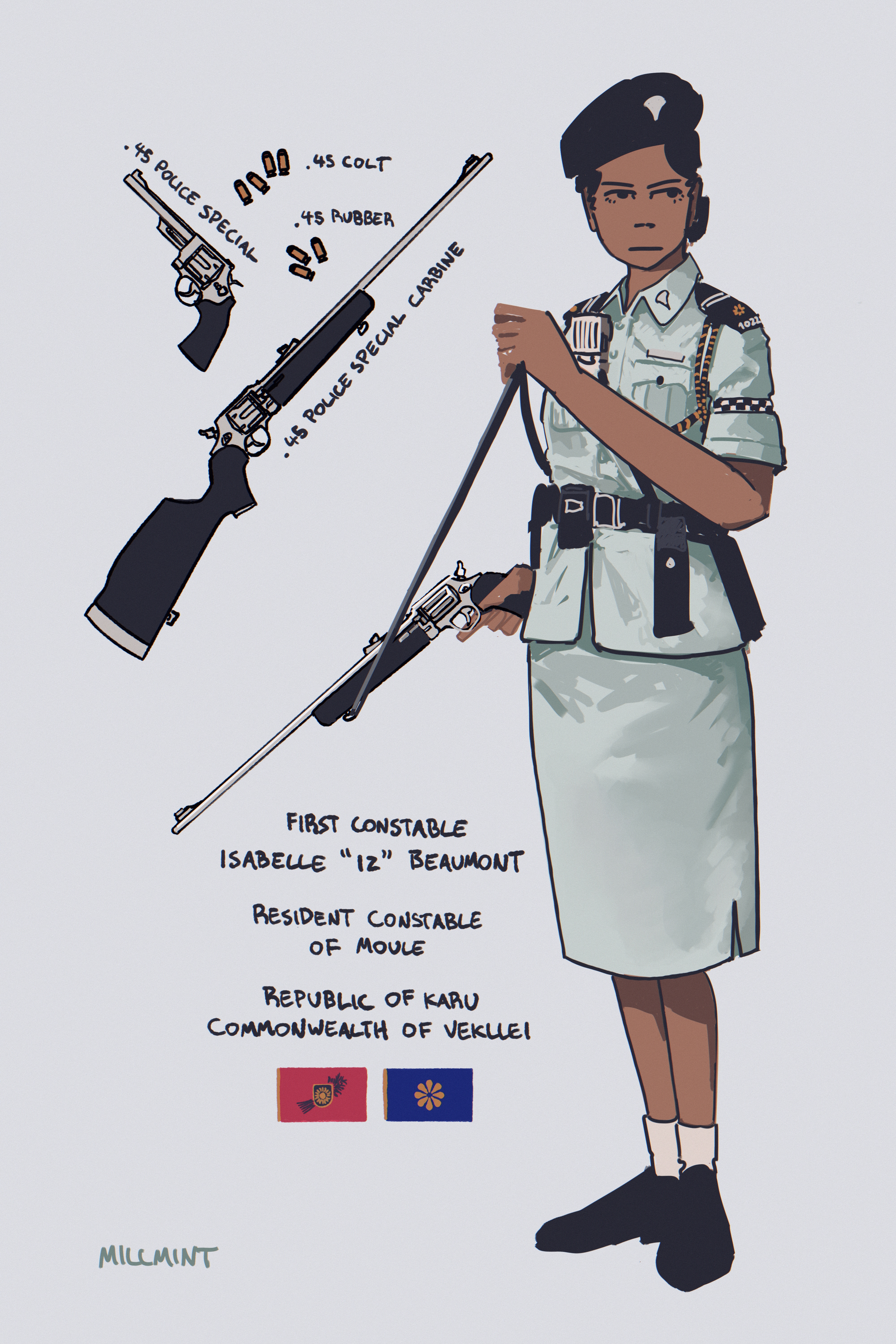
Commonwealth constables carry a combination of traditional and modern weapons. The standard sidearm is the .45 APC Police Special, a robust revolver designed specifically for law enforcement use. Officers also carry a lengthened carbine version of the same weapon, featuring a stock, lengthened barrel and foregrip that transforms the revolver into a short rifle for situations requiring greater range or accuracy. Both weapons use interchangeable ammunition, with officers carrying both steel and rubber cartridges depending on the situation, along with speed loaders for quick reloading. The Commonwealth is awash with military rifles but police don’t carry them as a conscious policy choice.
All constables are trained with sabres, which serve multiple practical purposes beyond their ceremonial significance. The extra reach and intimidation factor of a blade often prevents situations from escalating to firearms use, while the extensive saber training builds physical conditioning and discipline. Officers may opt to carry steel batons as well, or instead of the sabre in certain situations.
-
Vekllei does not typically gender titles, so women officers are also referred to as ‘policeman’. Specifying gender produces strange phrases like ‘woman policeman’ or ‘male policeman’. ↩︎
-
The Duty Roster System is primarily a computer programme. It overlaps with other Commonwealth transport data cleanly, meaning seargents can establish who can do what within a geographic area with two entries. ↩︎