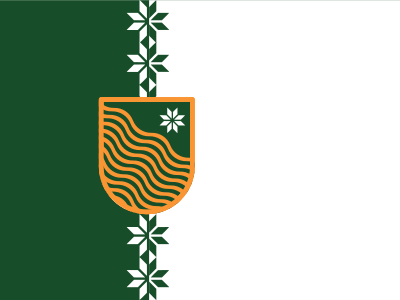
Kala is a constituent republic of Arctic Commonwealth.
| Kala Republic | |
|---|---|
| Island of Greenland | |
| Constituent Republic of Vekllei | |
 |
|
| Part of the Kalina Commonwealth | |
| Accession | 1836, as part of the British Atlantic Territories |
| Area | 2,166,086 km² |
| Capital | Kanek |
| Languages | Kalan, Aleutian Algic, English |
| Population | 482,448 |
The Kala Republic is a constituent republic of Vekllei, located 320km west of Oslola. It is the world’s largest island, and makes up the majority landmass and population centre of the Commonwealth Arctic. It is known for its rugged, mostly arctic terrain and interior glaciers that forms the second-largest ice sheet in the world. Kala plays a major part in the history of Vekllei Inuits (often called Algics) and the population today remains majority Algic.
Two thirds of Kala is above the arctic circle, and its climate is moderated only by the Gulf Stream across its populated southwest coast. The interior forms a permanent low-pressure system that circles cold air above the country, where permanent ice sheets form and feed peripheral glaciers. Dramatic weather changes are a part of Kalan life, and seasons experience both polar night and midnight sun during the solstices. Exposed terrain is mostly covered by low-lying tundra vegetation and a few species of Atlantic Pine. Polar bears, Arctic Oxen and Reindeer can all be found there.
Settlement in Kala dates back thousands of years, but its extensive history is poorly recorded compared to the Oslolan kingdoms. The island was home to the first permanent settlements of Vekllei Inuits, who inhabited the coastline and islands around the capital of Kanek at least 3,000 years ago. Unlike Oslola, Kala was not historically united under a single kingdom, and its harsh terrain prevented extensive trade between coasts. Local languages and culture on the east and west coasts are referred to in common as Kalan, but are seperate from each other, and have distinct identities.
Kala’s massive, though isolated, internal area is unique across Vekllei, and the country is home to many government installations. The public service remains the largest employer in the country, and most Kalans live in a few major metropolitan areas on the southwest coast. Due to the interior permafrost, the island has been slow to develop rail infrastructure common across other Vekllei republics. Life under its arctic climate has been improved by the limitless supply of fusion power provided by a reactor completed in 2026. As a consequence, streets and rails are able to be heated in winter and kept free of deep snow. Kanek is home to several major Vekllei companies, including National Machines and Common Gemstone. Major deposits of oil, coal, precious metals and uranium are mined there.
- Adhesives
- Chemicals
- Electronic Components
- Fish
- Glass
- Grains
- Lubricants
- Natural Gas
- Palm Oil
- Paper
- Plastics
- Printing Ink
- Pulp
- Pulses
- Rare Earths
- Salt
- Semiconductors
- Sulphur
- Timber
- Seqi Olivine Mine: Peridot mine in continuous operation for over three hunded years.
- Kala National Park: The world’s largest national park, comprising much of the island’s glacial interior.
- Commonwealth National Vault: Preservation vault of Vekllei government, libraries, technology and seeds, designed to survive a total nuclear war.
- Alavia: Historic site containing the oldest evidence of Inuit settlement in northern Kala, adjacent to a small village of the same name.
- Kala Arsenal Small arms and cold-weather ordnance workshop serving the arctic command.
- Kala Warm North Basin Offshore oil and gas field in the northern Arctic.
- Kala Cold South Basin Deepwater Arctic oil field.
- Kanek Metropolitan Railway Comprehensive urban transit system serving Kanek.
- Ilulissat Icefjord & Surrounds Tramway Scenic tramway serving the UNESCO World Heritage icefjord region.
- East Arctic Railway Company Long-distance rail service connecting the remote eastern settlements.
- Ruby Railway Company Specialised rail service serving the old gemstone mining districts, now a town and headquarters of Common Gemstone.
- Aurora Metropolitan Arctic Tramway Company Urban tram system serving the northern metropolitan areas.
- Upernavik Railway Remote rail service serving the northernmost settlements of Kala.
- Kala Polar Express Long-distance sleeper service crossing the Kalan interior.
- Scoresby Sound Scenic Railway Tourist and regional service serving the eastern fjords.
- Common Gemstone Corporate headquarters and primary facilities for the synthetic gemstone manufacturer.
- Mesters Vig Aeromanufacturie Major GAF complex and air base serving the northern command.
- Kala Cold-Weather Nuclear Generation Establishment 2.5 GW arctic-rated fission station.
- Deep Particle Observatory Neutrino detector installation and base of the secret Atlantic Neutrino Surveillance System.
- LSRE Arctic Division Specialist research complex and base of arctic circle expeditions.
- Method Pipeline Works High-pressure equipment and infrastructure works serving the Arctic energy sector.
- National Machines Headquarters Primary design studios and robotics manufacturing hub for the computing bureau.
- Air Station Kala Air Station Kala is a military air station of the Vekllei Air Service, located in the republic of Kala. Home to the Police Detachment of the National Ranger School.
- Naval Station Sedna Naval Station Sedna is a maritime facility of the Vekllei Maritime Service located in the republic of Kala.
-
2035
The Nuclear Thermal Working Group conducts nuclear rocketry experiments in Kala
-
2026
Fusion power plant completed in Kala, the second of its kind in Vekllei
- 1951
- 1935
-
1836
The British Overseas Territories comprising Oslola, Kala and Demon are reincorporated as the British Atlantic Territories, including Anguilla, Lucaya, Habacoa, Summers, the Virgin Islands, the Cayman Islands ( Caimanas), the Falklands, Montserrat ( Allia), Saint Helena ( Helena), Ascension ( Ascension), the Tristan da Cunha Islands ( Santes), the South Georgia and Sandwich Islands ( Sude), and the Turks and Caicos ( Caicos) Islands
-
1726
Seqi Olivine Mine begins continuous operation in Kala
-
1440
Kala enters a union with the 3rd Commonwealth
-
1000 BC
Earliest permanent Algic settlements established at Kanek and Alavia in Kala