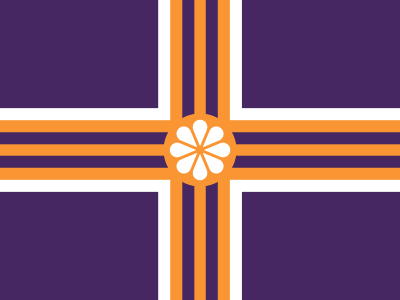
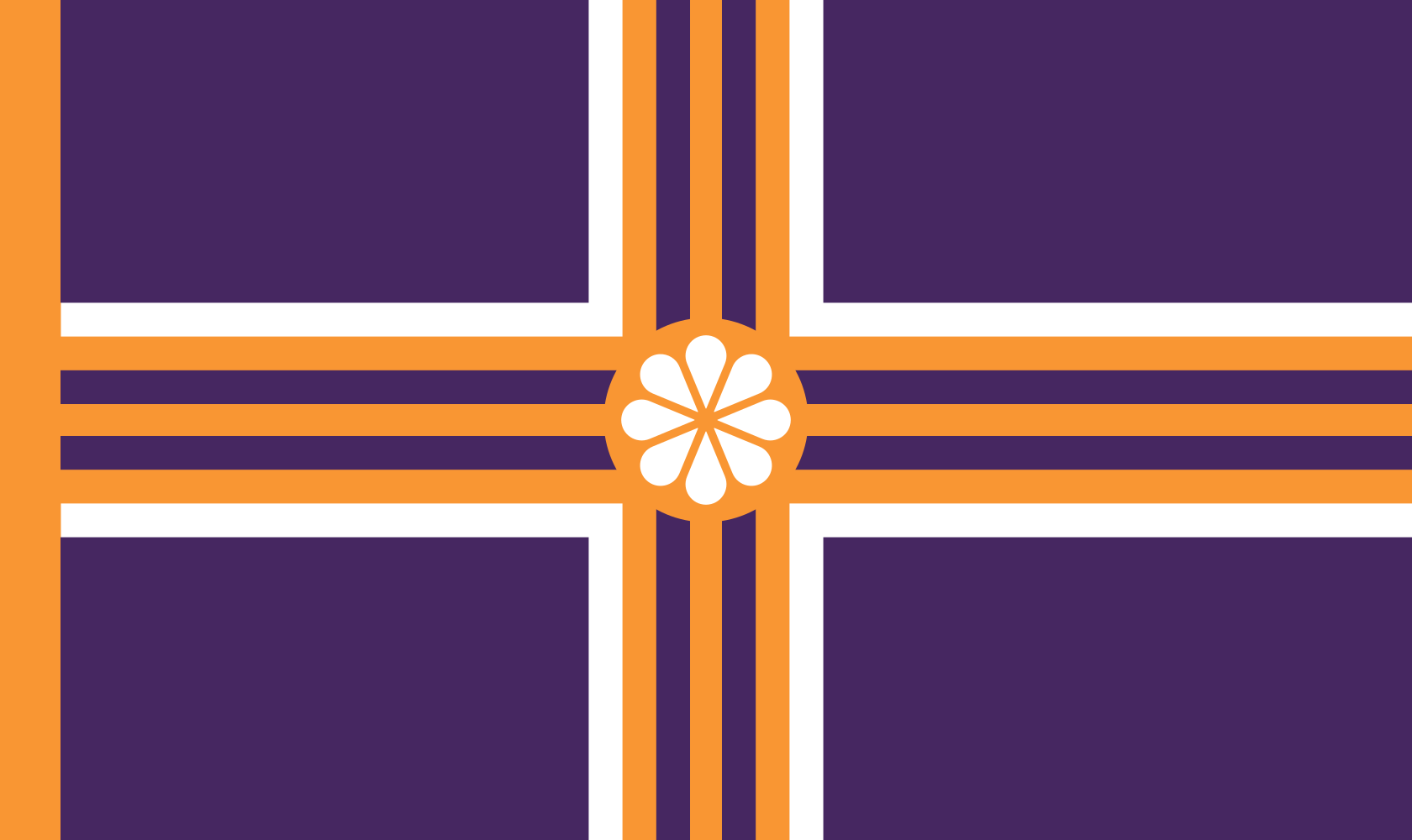
| Liamuiga Republic | |
|---|---|
| Island of Saint Christopher (Saint Kitts) | |
| Constituent Republic of Vekllei | |
 |
|
| Part of the Kalina Commonwealth | |
| Accession | 1978, as part of final Antilles accession |
| Area | 174 km² |
| Capital | Basseterre |
| Languages | English, Kittitian Creole |
| Population | 61,203 |
The Liamuiga Republic is a constituent republic of Vekllei in the northern Kalina Commonwealth, northwest of Antigua and south of Barbary. The island takes its name from the indigenous Kalinago word meaning “fertile land,” a reference to the rich volcanic soils that have shaped its history for centuries. The name was officially adopted upon Commonwealth accession in 1978, replacing the colonial designation of Saint Christopher.
The island is dominated by Mount Liamuiga, an extinct volcano rising 1,156 metres at its northwestern end. The mountain’s forested slopes and crater lake are visible from nearly every settlement. A central mountain range runs northwest through the island, with foothills descending toward cultivated coastal plains. The Southeast Peninsula presents a stark contrast – a narrow finger of land characterised by salt ponds, scrubland, and white sand beaches, connected to the main island by a thin isthmus.
Liamuiga shares a complex history with its smaller neighbour Oualie, visible across the narrow channel to the southeast. The two islands were administered together under British colonial rule and were briefly associated as a federation. When both joined the Commonwealth in 1978, they did so as separate constituent republics, finally resolving decades of constitutional tension. The channel between them now sees regular hydrofoil service, and they compete only in cricket.
European colonisation began in 1624 when Sir Thomas Warner established the first permanent British settlement in the Caribbean at Old Road Town. For the next two centuries the island changed hands repeatedly between British and French control, culminating in the Siege of Brimstone Hill in 1782. When British control was secured in 1783, Liamuiga became one of the Caribbean’s most profitable sugar colonies, its wealth built on the labour of enslaved Africans. The abolition of slavery in 1834 began a long economic decline that lasted over a century. Attempts to diversify into tourism and light manufacturing in the mid-20th century were only partially successful, and the economy remained fragile and dependent on remittances.
Commonwealth accession in 1978 marked a dramatic turning point. The old sugar estates have been portioned off to smallholders and beautiful vertical hydroponic farms that look straight out of science fiction. The volcanic soils now produce vegetables, root crops and tropical fruits for domestic consumption across Kalina. Small-scale specialty agriculture has flourished – cocoa, coconuts and exotic spices on the mountain slopes, with sea island cotton in the drier Southeast Peninsula. This has afforded many communities on the island substantial investment from the federal government, and they now boast new schools and parks.
The capital, Basseterre, has been substantially rebuilt. The old colonial core around Independence Square has been preserved, but surrounding it are new government buildings, a modern teaching hospital and expanded port facilities. A tram line now runs from Basseterre around the coast to the northern settlements, with a branch line serving the agricultural interior.
Next to vegetables, education has become a primary sector of the Liamuigan economy. The island is home to the Liamuiga School of Teaching, a constituent campus of the Commonwealth University of the West Indies that trains primary and secondary teachers for the entire Kalina region. Students from across the Commonwealth come to study there, and the island’s schools serve as practicum sites for student teachers.
Brimstone Hill Fortress, the massive 18th-century fortification on the northwest coast, has been extensively restored and now serves as both an archive and research centre for Caribbean colonial history, operated by the Commonwealth Central Archives. The old sugar estates have been preserved as a belt of municipal farms, with a handful operating as working museums using traditional methods for educational purposes.
Most Liamuigans are descended from Africans brought to the island as slaves. The population speaks English in formal settings and Kittitian Creole among themselves. Liamuigan cuisine is hearty and flavourful. Stewed saltfish with spicy plantains remains the national dish, while goat water – a thick stew of goat meat, breadfruit and dumplings that is tastier than it sounds – is served at celebrations. The island produces excellent rum from locally-grown sugarcane, and the tradition of “liming” – gathering with friends to drink, talk and play dominoes – remains central to social life.
Climate
Tropical with a dry season from January to April and a wet season from May to November. The interior mountains receive more rainfall than the coasts, and the Southeast Peninsula is notably drier than the rest of the island.
Public Holidays
- New Year’s Day 1 Jan
- Carnival Last Lap 2 Jan
- Good Friday
- Easter Monday
- Commonwealth Day 1 May
- Whit Monday
- Emancipation Day 1 Aug
- Republic Day 19 Sep
- Christmas Day 25 Dec
- Boxing Day 26 Dec
- Molasses
- Sea Island Cotton
- Sugar
- Mount Liamuiga: Extinct volcano with hiking trails to the crater rim and lake, offering panoramic views across the northern Caribbean.
- Brimstone Hill Fortress: Massive 18th-century British fortification, now a regional archive and research centre operated by the Commonwealth Central Archives.
- Liamuiga School of Teaching: Regional teacher training campus of CUWI, specialising in primary and secondary education pedagogy.
- Romney Manor: Historic sugar estate with preserved colonial buildings and botanical gardens, now operating as an agricultural museum and working farm.
- Old Road Town: Site of the first British settlement in the Caribbean (1624), with preserved colonial architecture and archaeological sites.
- Southeast Peninsula Nature Reserve: Protected salt ponds and scrubland serving as migratory bird habitat and dryland agriculture research station.
- Independence Square: Historic centre of Basseterre with colonial-era buildings, including the old Treasury and St George’s Anglican Church.
- Black Rocks: Dramatic volcanic rock formations on the northern coast, formed by ancient lava flows meeting the sea.
- Bloody Point: Historic site where British and French colonists massacred the Kalinago population in 1626, now a memorial and archaeological site.
- Basseterre Teaching Hospital: Modern medical facility serving the northern Kalina republics, with specialist departments in tropical medicine and emergency care.
- Brimstone Hill House Exclusive lodge located within the historic Brimstone Hill Fortress complex.
- Brimstone Hill Fortress Massive 18th-century British fortification, now a regional archive and research centre.
- Basseterre Sugar Railway Historic railway serving the island of St. Kitts.
- Liamuiga School of Teaching Centre for Atlantic Model teaching and pedagogical research.